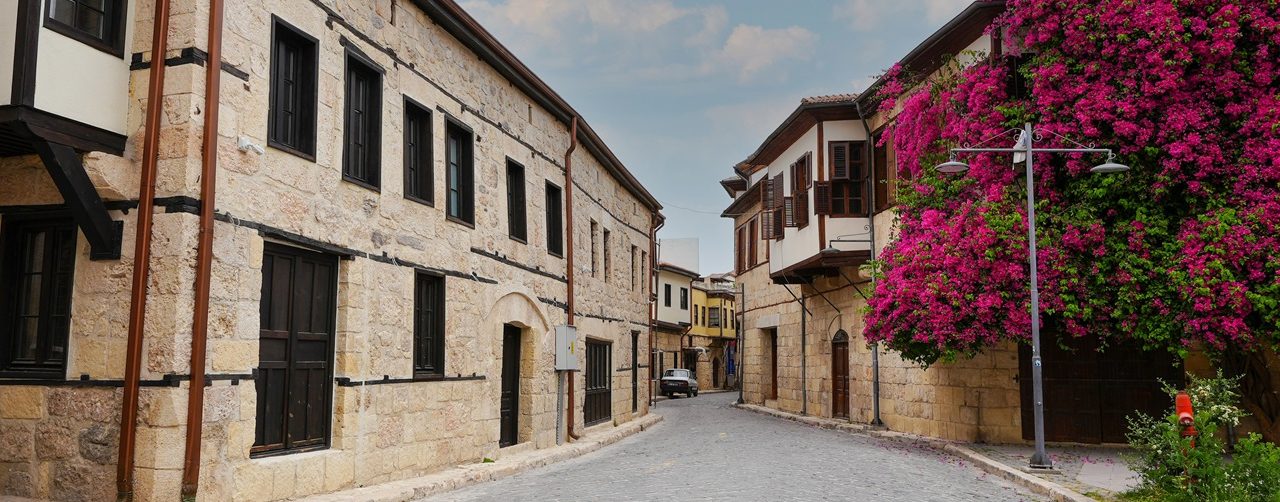
It is surrounded by Adana to the east, Mersin to the west, Pozantı and Çamlıyayla to the north, and the Mediterranean to the south. Tarsus, which has been the melting pot of various cultures since the Neolithic period with its history and geography and has a strategic importance in Ancient Cilicia, is at the crossroads of historical roads connecting Cilicia to Central Anatolia.
Due to its connection to the Mediterranean with Lake Regma to the south, it was a port city open to maritime trade in the early and middle ages. The name of Tarsus was first mentioned in Hittite texts as ‘Tarşa’.
According to the Assyrians, it was the capital of the Que Kingdom. In the 8th and 7th centuries BC, the Assyrians called Tarsus Tarzi (Tarzu). Its name did not change during the Assyrian and Syennesis Kingdoms in the 6th-5th centuries BC. The name Tarsus can also be found on the coins minted by the Persians in Tarsus. According to the Arabic history called ‘Miratüliber’, Tarsus was founded by Tarasis, the grandson of Prophet Noah. The name of Tarsus was first used as Tarsos in Greek and later as Tarsus in Latin. The legend about its foundation is as follows: In ancient times, the local Cilician people named the Tarsus River Kydnos and Kydnos’ son Parthenia founded a city with his own name where Kydnos empties into the sea. This city, which was founded when the waters receded after the Flood, was called Tersein (to dry up). It is stated in the Torah as Ephsus, in the Bible as Arsus and in Islamic sources as the founder of Tarsus by Prophet Seth, the son of Hz. Adam. Archaeological excavations carried out in Gözlükule in the center of Tarsus show that its history goes back to 7000 BC.
Archaeological findings show that the Neolithic society settled around Gözlükule Mound made their living from agriculture and trade. Stone and metal tools were used in the Chalcolithic period around 5000 BC. Thanks to its trade relations between 3000-1200 BC, Tarsus gained importance among the cities of Cilicia and became a trade center. During this period, the Hittite Empire ruled in Central Anatolia and the Kizzuwatna kingdoms in Cilicia. A seal impression belonging to Ishputahsu, the son of the King Parivavatri of Kizzuwatna, was found in the Gozlukule excavations. In 1650 BC, a treaty was made between the Hittite King Telepinus and the King Ishputahsu of Kizzuwatna. Tarsus and Cilicia were annexed to the Hittite Empire after 1500 BC. The Hittite Empire disintegrated in 1200 BC and many small principalities and kingdoms were formed in Anatolia and Cilicia between 1200-839 BC.
Tarsus was the capital of one of these kingdoms. Assyrian texts tell of King Salmanassar II’s four expeditions to the Que Kingdom in Cilicia, dethroning King Kate of Tarsus and placing his brother Kirri on the throne. The discovery of cedar trees in the region led Phoenician merchants to establish a commercial base in Tarsus. During the reign of the Assyrian King Salmanassar V in 727-722 BC, Tarsus became a province of the Assyrian Kingdom. During the reign of King Sargon II in 722-705 BC, the Principality of Que protected the Assyrian lands in the west. The rebellion movements of Kirua, the governor of Illibru (Namrun), which started in Tarsus in 705-681 BC, were suppressed by the Assyrian King Sennacherib. Behind the scenes of this rebellion against the Assyrians were the western kingdoms. Their aim was to seize the Cilician plain and the mines in the Taurus Mountains.
During the reign of the Assyrian King Sardanapal (668-626), Cilicia was defeated by the Cimmerians. With the collapse of the Assyrian Kingdom, the Kingdom of Syennessis, with its capital in Tarsus, was established in 612 BC. According to Xenophon, Epyaka, the wife of the King of Cilicia Syennessis, had a close relationship with the Persian King Cyrus. After the war in Tarsus, a treaty was made between Syennessis and Cyrus. This treaty was broken with the death of Cyrus. The Kingdom of Syennessis in Cilicia continued until 401 BC. From 401 BC onwards, Cilicia became a province of the Persian Empire and the names of the Persian satraps appeared on the coins of Tarsus. Tiribazzos in 388-380 BC, Farnabazos in 379-371 BC, Datames in 379-373 BC, 372-369 Tarhamos, 368-333 BC Persian satraps such as Mazaios dominated Tarsus. Macedonian King Alexander the Great conquered Tarsus in 333 BC and defeated the Persian satrap Arsemes, ending Persian rule in Cilicia. He brought Balakros, the son of his commander Nikador, to power in Tarsus for a temporary period. While Alexander the Great was on his eastern campaigns, Balakros lived an extraordinary life with his lover Glikira in the Tarsus King’s palace. Learning of this, Alexander the Great brought one of his commanders, Philatos, in place of Balakros.
After Alexander the Great’s death, the empire disintegrated in 323 BC. Cilicia and Tarsus fell into the hands of one of his generals, Seleucus Nikator. Seleucus Nikator moved the center of the Seleucid Kingdom, which was named after him, from Babylon to Antioch. In 323 BC, Until 312-64, Tarsus changed hands frequently between the Anatolian Kingdoms, the Ptolemies (Egypt), the Seleucids and the Romans. The first Roman governor here was Claudius. According to information obtained from Strabon, the Roman orator Cicero was the provincial governor of Tarsus in 51-50 BC. In 48 BC, Julius Caesar came to Tarsus and put an end to the poverty and misery of the people and made arrangements in the administration. In return for these good deeds of the emperor, the people honored Caesar by naming Tarsus Juliusopolis. After Julius Caesar died in 44 BC, Antonius, who succeeded him, came to Tarsus and ensured the development of the city with construction works.
Antonius transferred the world’s oldest library from Pergamon to Tarsus. Tarsus, which became rich in a short time, attracted the attention of the world. Cleopatra and Antonius provided unforgettable services for Tarsus. Returning to Egypt, Cleopatra persuaded Antonius to come to Egypt and they got married in 37 BC. In 34 BC, the Romans declared war on Cleopatra and Antonius by decision of the Roman Senate. Cleopatra and Antonius were defeated and Antonius killed himself. After the Battle of Actium, Augustus annexed all Roman lands and rewarded Tarsus, which remained loyal to him. Tarsus became rich enough to rival Ephesus. In 31 BC, Emperor Augustus forgave Tarsus for the political role it played in the Battle of Actium. He appointed Athenodoros, the son of his tutor Sadon of Tarsus, as governor of Tarsus. He provided great services for Tarsus between 30 BC and 7 AD. Saint Paul was born in Tarsus during these years. Emperor Hadrian visited Tarsus in 117. During the reign of Emperor Antonius Pius, Tarsus became not only the capital of Cilicia but also the administrative center of Lyconia and Isauria regions. In 260, Persian ruler Sapur invaded Cilicia and plundered Tarsus. In 261, the Syrian Pamir Kingdom alliance defeated the Persian King Shapur and captured all of Cilicia. However, Emperor Aurelian defeated the Pamir Kingdom in 270-275 and annexed Cilicia to Roman territory again. Tacitus saved Cilicia from the invasion of the Gothic Kingdom in Anatolia in 275-276. Tarsus became a Roman province in 284-305. During this period, Christian rebellions began against the polytheistic belief, which was its official religion. Emperor Diocletian settled in Tarsus at this time. He applied pressure and massacred many Christians. According to a legend, during the reign of this emperor, seven young Christians were killed 14 km from the city. They took refuge in the Eshab-ı Kehf Cave in the northwest and the widespread legend mentions them. However, it is not certain that the emperor was Diocletian. During the reign of Emperor Constantine I in 306-337, the rebellions in the Roman provinces ended. During the reign of Constantine, who made Istanbul the center of government, Christianity received great help. Tarsus gained importance again during the reign of Julian Apostata (361-363), who ascended to the throne after Constantine II (337-361). The emperor, who died in the Persian wars in 363, was buried in Tarsus at his own request. Cilicia and Tarsus, which were taken by the Roman commander Pompeius, remained under Roman rule until 459 and maintained their superiority in economic and commercial areas during this period.
Olive and viticulture gained importance along with agriculture, and the city walls lost their importance. In 395, the Roman Empire was divided into two, and Tarsus remained in Eastern Roman territory. The first emperor of the Eastern Roman Empire, Arcalius, divided the province of Cilicia into three as Tarsus, Seleucus and Anazarbos in 395-408. Emperor Justinianus started construction activities in Tarsus in 527-565. During this period, in order to protect Tarsus from the floods of the Kydnos (Berdan) River, Justinianus changed the bed of the Kydnos River and moved it to the east of the city.
The Tarsus Waterfall was formed at this time. The walls, which were severely damaged in the earthquake in the 6th century, were repaired again. Tarsus changed hands frequently between the Byzantine Empire, Iran and the Arabs from the 7th century onwards. The Umayyad Caliph Muawiyah and the Abbasid Caliph Harun al-Rashid captured Tarsus in turn. In 965, the army stayed in Tarsus during the Arab campaigns in Anatolia. Caliph Me’mun died in the battle in Pozantı and was buried in Tarsus. One of the tombs in the Ulu Mosque belongs to this caliph. Tarsus lost its former economic and commercial superiority due to the changes in hands during the Anatolian Seljuk State, the Crusades and the Mamluk period. After 1375, it came under the rule of the Ramazanoğulları and Dulkadiroğulları Principality, and after 1517 it was incorporated into the Ottoman lands. In 1832, İbrahim Pasha, the son of the Egyptian Khedive Kavalalı Mehmet Ali Pasha, came to Tarsus and during this period the walls surrounding Tarsus were demolished.
Only the Cleopatra Gate remained of these walls. In 1839, it came under Ottoman rule again and became a district of the Adana province. It was invaded by the French in 1918 and was liberated from the occupation with the Ankara Treaty on December 27, 1921. Meanwhile, the building, which was completed in 1950 and used as the city’s courthouse for 59 years, was allocated to the Ministry of Culture and Tourism by the National Real Estate Directorate in 2013 to be organized as the New Tarsus Museum with the opening of the new courthouse. The restoration and display-arrangement works initiated for the building to be used as the New Tarsus Museum were completed and the museum was opened on 22.12.2020.
There are 805 archaeological artifacts, 404 ethnographic artifacts and 810 coins in the display section of the Yenir Tarsus Museum. Among the archaeological artifacts, there are artifacts from the Paleolithic, Neolithic, Chalcolithic, Bronze Age, Iron Age, Archaic, Classical Age, Hellenistic Period, Roman, and Eastern Roman Periods. Among the ethnographic artifacts, there are artifacts from the Ottoman and Republican Periods. Coins from the Greek, Hellenistic, Roman, East Roman, Islamic (Abbasid, Umayyad, Ilkhanate, Artuqid, Seljuk, Ottoman) and European periods are also exhibited. There are also silicone mannequins, dioramas, ballistrols and interactives. Our museum also has a small mosque, a souvenir shop, a cafe, a baby care room and an elevator for our disabled citizens.